- Uw winkelwagen is leeg
- Verder Winkelen


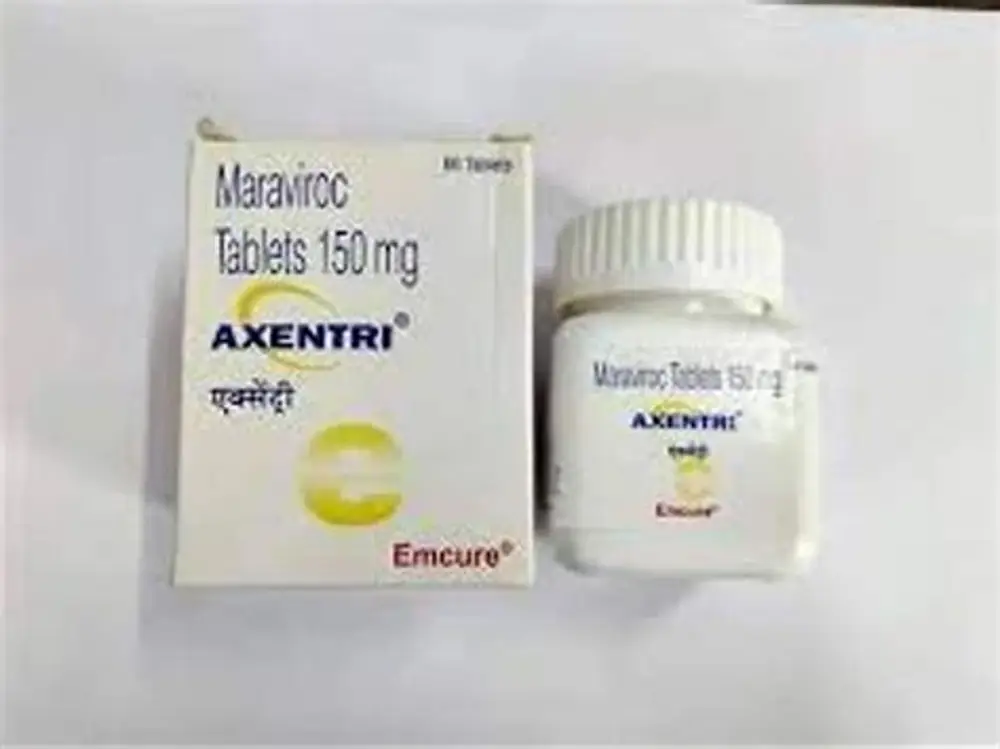

€370Huidige prijs: €370. Oorspronkelijke prijs was: €400.
Axentri 150 mg (maraviroc film-coated oral tablets) is a prescription-only chemokine receptor antagonist (CCR5 co-receptor antagonist) indicated for the treatment of only CCR5-tropic Human Immunodeficiency Virus type 1 (HIV-1) infection in combination with other antiretroviral agents. Unlike conventional antiretroviral classes that target intracellular viral enzymes, maraviroc acts extracellularly on host cells as an entry inhibitor, binding to the human CCR5 chemokine receptor to prevent viral envelope attachment and membrane fusion. Clinical administration mandates prior confirmation of CCR5 tropism via diagnostic testing. Dispensed strictly by medical prescription.
Axentri 150 mg delivers maraviroc, a synthetic small-molecule antagonist of the human C-C chemokine receptor type 5 (CCR5). In antiretroviral therapy (ART), maraviroc represents a host-targeted therapeutic approach: by selectively binding to host cell surface receptors rather than targeting viral proteins directly, it prevents HIV-1 from infiltrating healthy $\text{CD4}^+$ T-cells and macrophages, reducing viral load and raising systemic $\text{CD4}^+$ lymphocyte counts.
Clinical Profile & Formulation
Active Pharmaceutical Ingredient: Maraviroc (150 mg per tablet).
Dosage Form & Identification: Film-coated, biconvex oral tablet, typically debossed with strength identifiers.
The 150 mg Strength Role: Maraviroc clearance is extensively mediated by cytochrome P450 enzymes. The 150 mg tablet serves as the designated clinical dose tier administered twice daily (150 mg BID) when co-prescribed with potent CYP3A inhibitors (such as ritonavir, cobicistat, atazanavir/r, or darunavir/r).
Pharmacodynamics & Mechanism of Action
Negative Allosteric Modulation of CCR5: Maraviroc binds stereospecifically into a deep transmembrane hydrophobic pocket of the human CCR5 chemokine co-receptor on the surface of host $\text{CD4}^+$ cells.
Entry Inhibition & Fusion Blockade: Binding locks the CCR5 receptor in an inactive conformation without activating intracellular G-protein signaling. This conformational lock prevents the V3 loop of the viral envelope glycoprotein gp120 from binding to CCR5 following its initial attachment to the $\text{CD4}$ receptor.
Prevention of gp41 Activation: Without gp120-CCR5 binding, the secondary conformational restructuring of the transmembrane glycoprotein gp41 (insertion of the fusion peptide and formation of the six-helix bundle) cannot occur, completely arresting the fusion of viral and host cellular lipid bilayers.
Strict Tropism Selectivity: Maraviroc has no intrinsic activity against viruses that utilize the CXCR4 chemokine co-receptor (X4-tropic) or against dual/mixed-tropic (D/M-tropic) strains.
Mandatory Diagnostic Tropism Testing
Pre-Treatment Requirement: Prior to initiating maraviroc therapy, patients must undergo validated phenotypic tropism testing (e.g., the Trofile® assay) or high-sensitivity genotypic sequencing of the viral envelope env V3 loop.
Clinical Utility: If CXCR4-tropic or dual/mixed-tropic virus is detected, maraviroc is ineffective and must niet be prescribed. Re-emergence or unmasking of pre-existing CXCR4-tropic viral reservoirs during therapy can result in virologic failure.
Pharmacokinetics & Cytochrome P450 Modulation
Absorption: Rapidly absorbed following oral ingestion, reaching peak plasma concentrations ($C_{\max}$) within 1 to 4 hours. Absolute bioavailability ranges from 23% to 33%.
Distribution: Moderately bound to circulating human plasma proteins (~76%), primarily to albumin and $\alpha_1$-acid glycoprotein.
Hepatic Biotransformation: Extensively metabolized hepatically via cytochrome P450 3A4 (CYP3A4) into inactive mono-oxygenated and $N$-dealkylated metabolites.
Substrate of P-gp & CYP3A4: Susceptible to major drug interactions requiring mandatory dosage modifications:
150 mg BID: When administered with potent CYP3A inhibitors (e.g., boosted protease inhibitors, delavirdine, ketoconazole).
300 mg BID: Baseline dose when administered with neutral agents (e.g., NRTIs, tipranavir/ritonavir, raltegravir, nevirapine).
600 mg BID: When administered with potent CYP3A inducers (e.g., efavirenz, rifampin, carbamazepine, St. John’s wort).
Elimination: Displays a terminal elimination half-life of 14 to 18 hours. Elimination occurs primarily through feces (~76%, with ~20% as unchanged drug) and urine (~20%, with ~8% as unchanged parent drug).
Safety Considerations, Boxed Warnings, & Monitoring
Hepatotoxicity Boxed Warning: Maraviroc carries a Boxed Warning regarding severe, potentially life-threatening hepatotoxicity. Hepatic dysfunction may be preceded by a systemic allergic or hypersensitivity reaction, presenting with pruritic maculopapular rash, eosinophilia, fever, elevated serum IgE levels, and transaminase elevations. Treatment must be discontinued immediately if signs of hepatitis or allergic reaction manifest.
Cardiovascular & Orthostatic Hypotension: Postural hypotension can occur, particularly in patients with severe underlying renal impairment co-administered with CYP3A inhibitors. Caution is warranted in individuals with preexisting coronary artery disease or autonomic neuropathy.
Immune Reconstitution Inflammatory Syndrome (IRIS): Patients initiating combination therapy may experience an acute inflammatory flare to indolent or residual opportunistic infections (e.g., Mycobacterium avium, cytomegalovirus, Pneumocystis jirovecii pneumonia).
Risk of Infection: Chemokine receptors modulate leukocyte trafficking; theoretical concerns regarding increased susceptibility to certain endemic infections (e.g., West Nile virus) warrant clinical vigilance.

 English English
  German
 Italian
 Dutch
Dutch
 Spanish


Beoordelingen
Er zijn nog geen beoordelingen.