- Tu carrito está vacío
- Continuar comprando




€220Precio actual: €220. Precio Original era: €250.
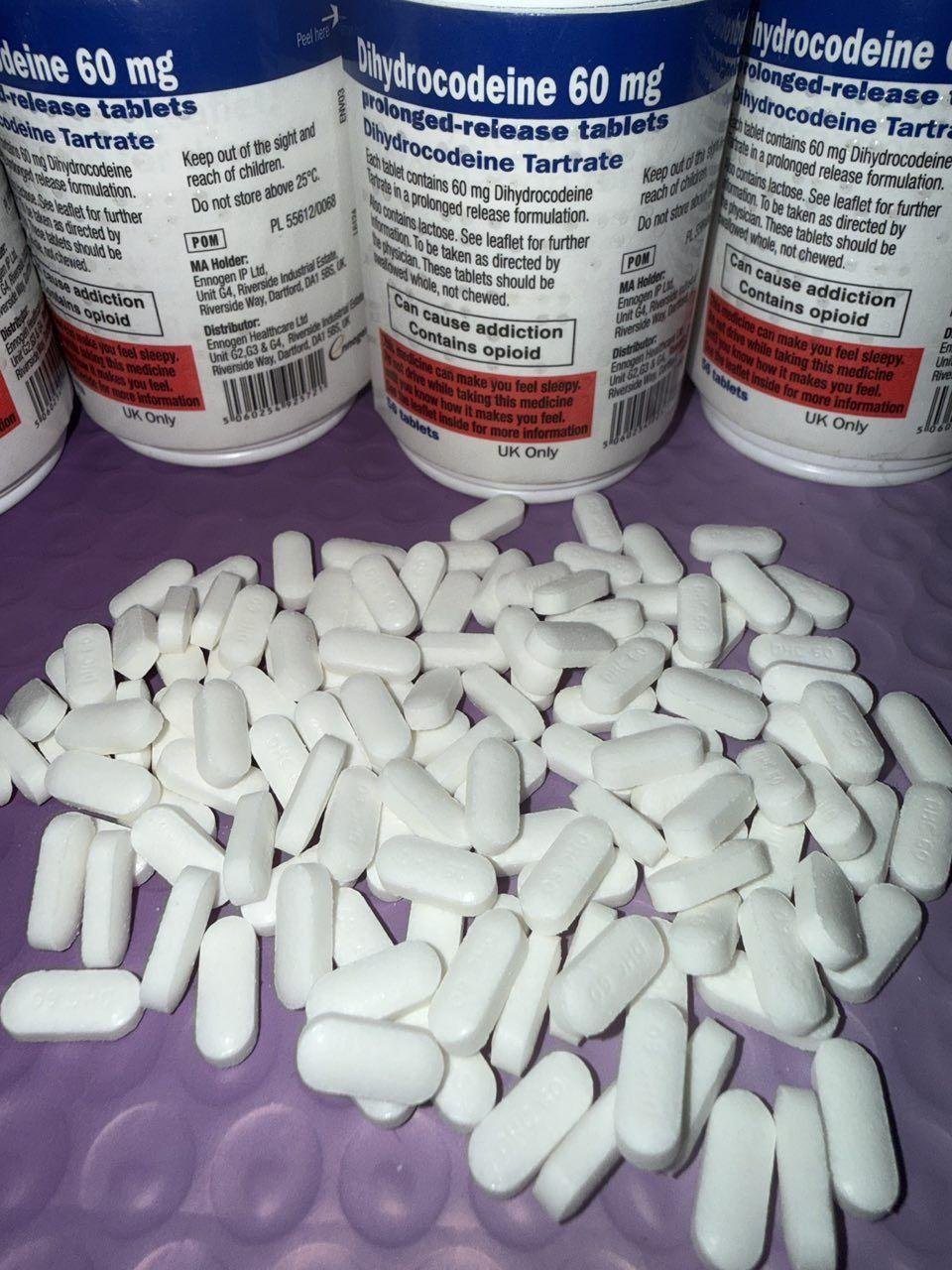
Dihydrocodeine 60 mg (commonly formulated as dihydrocodeine tartrate prolonged-release) is a semi-synthetic opioid analgesic indicated for the management of moderate to severe chronic pain when non-opioid analgesics are inadequate. Functioning primarily through metabolic activation to dihydromorphine alongside direct weak $\mu$-opioid receptor agonism, it modifies central pain perception and ascending nociceptive pathways under direct medical supervision. Dispensed strictly by valid prescription.
Dihydrocodeine 60 mg oral tablets deliver a semi-synthetic morphinan opioid analgesic designed for the continuous management of moderate to severe pain refractory to non-opioid therapies. Frequently utilized in oncological palliative care, severe musculoskeletal disorders, and post-operative recovery, this 60 mg modified-release formulation provides consistent 12-hour analgesia positioned clinically between weak opioids (such as codeine) and strong $\mu$-agonists (such as morphine or oxycodone).
Clinical Profile & Physical Properties
Active Ingredient: Dihydrocodeine tartrate (60 mg per tablet).
Dosage Form: Typically manufactured as a modified-release / continuous-release matrix tablet (e.g., round, off-white to pale yellow, debossed with identifiers such as “DHC 60”) engineered to provide steady systemic absorption.
Mechanism of Action: Acts as an agonist at central and spinal $\mu$-opioid receptors ($\text{MOR}$). A significant portion of its analgesic efficacy is mediated through O-demethylation into dihydromorphine, which displays roughly 100-fold higher affinity for $\mu$-receptors than the parent drug. Receptor activation triggers inhibitory $G_i$-protein signaling, decreasing intracellular cyclic AMP, closing voltage-gated calcium channels, and stimulating potassium efflux to attenuate nociceptive neurotransmission.
Pharmacokinetics & Metabolism
Bioavailability & Absorption: Well absorbed via the gastrointestinal tract with an oral bioavailability of approximately 20% due to first-pass hepatic metabolism. Modified-release tablets flatten peak-to-trough plasma variations over a 12-hour dosing interval.
Hepatic Biotransformation: Extensively metabolized in the liver via three primary pathways:
Glucuronidation to dihydrocodeine-6-glucuronide (predominant pathway).
$N$-demethylation via CYP3A4 to nordihydrocodeine.
$O$-demethylation via polymorphic CYP2D6 to the active metabolite dihydromorphine.
Elimination: Excreted predominantly through the renal system as unchanged drug and polar conjugated metabolites, with an elimination half-life averaging 3.5 to 5 hours.
Prescribing Protocols & Administration
Tablet Integrity: Modified-release tablets must be swallowed whole with water. Crushing, chewing, breaking, or dissolving the tablet destroys the polymer release matrix, precipitating rapid drug release (“dose dumping”) and acute systemic toxicity.
Dose Individualization: Must be titrated to the minimum effective dose required to achieve clinical pain endpoints. Discontinuation after prolonged use requires a structured tapering schedule to avoid autonomic withdrawal symptoms.
Important Safety Information & Boxed Warnings
Addiction, Abuse, and Misuse: Dihydrocodeine is a controlled substance with significant potential for psychological dependence, tolerance, misuse, and diversion.
Life-Threatening Respiratory Depression: Serious, potentially fatal respiratory depression can occur, with highest susceptibility during initial therapy or following dosage increases.
Risks with CNS Depressants & Alcohol: Concurrent administration with benzodiazepines, barbiturates, other sedatives, or alcohol significantly increases the risk of profound sedation, respiratory arrest, coma, and death.
Contraindications: Contraindicated in patients with acute respiratory depression, severe obstructive pulmonary disease, acute asthma, or known paralytic ileus.
 English English
  German
 Italian
 Dutch
Dutch
 Spanish

Reseñas
Todavía no hay reseñas.