- Ihr Warenkorb ist leer
- Weiter Einkaufen




€180Der aktuelle Preis ist: €180. Original Preis wurde: €200.
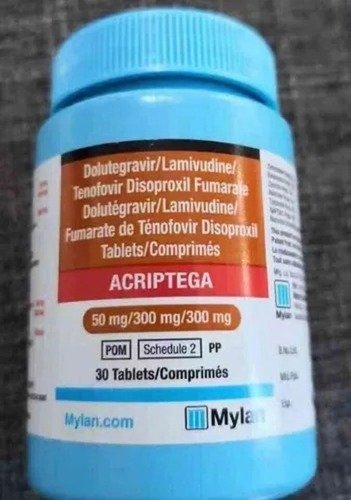
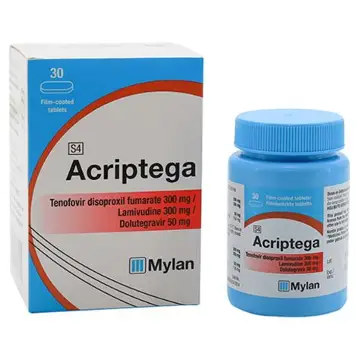
Acriptega is a fixed-dose combination (FDC) prescription antiretroviral tablet containing dolutegravir (50 mg), lamivudine (300 mg), and tenofovir disoproxil fumarate (300 mg), collectively known as the TLD regimen. Endorsed by the World Health Organization (WHO) as a preferred first-line and second-line regimen for adults and adolescents living with HIV-1, Acriptega integrates an integrase strand transfer inhibitor (INSTI) with two nucleoside/nucleotide reverse transcriptase inhibitors (NRTIs). This combination provides rapid viral suppression, a high genetic barrier to resistance, and favorable tolerability in a convenient once-daily single-tablet regimen. Dispensed strictly by medical prescription.
Composition: Dolutegravir 50mg, Lamivudine 300mg, Tenofovir Disoproxil Fumarate 300mg
Manufactured By: Mylan Pharmaceuticals
Form: Tablet
Packing: Pack of 30 Tablets
Acriptega represents a major standard of care in global HIV management. By combining three active antiretroviral agents with complementary mechanisms into a single solid-dose oral tablet, Acriptega minimizes pill burden, promotes long-term treatment adherence, and provides durable suppression of human immunodeficiency virus type 1 (HIV-1) ribonucleic acid (RNA).
Active Pharmaceutical Constituents & Formulation
Dolutegravir (as sodium): 50 mg — A second-generation integrase strand transfer inhibitor (INSTI).
Lamivudine (3TC): 300 mg — A synthetic nucleoside reverse transcriptase inhibitor (NRTI).
Tenofovir Disoproxil Fumarate (TDF): 300 mg (equivalent to 245 mg tenofovir disoproxil) — An acyclic nucleotide diester reverse transcriptase inhibitor (NtRTI).
Dosage Form: Film-coated, capsule-shaped oral tablet designed for once-daily administration.
Pharmacodynamics & Multi-Target Mechanism of Action
Inhibition of Viral Genome Integration (Dolutegravir): Dolutegravir selectively targets HIV integrase by chelating the two divalent magnesium ($\text{Mg}^{2+}$) ions within the enzyme’s catalytic core. This arrests the essential “strand transfer” step of viral DNA integration into the host cell chromosome, preventing transcription of downstream viral proteins and terminating the replication cycle. Its slow dissociation kinetics confer a high genetic barrier to resistance.
Dual Reverse Transcriptase Inhibition & Chain Termination (Lamivudine & Tenofovir DF):
Lamivudine: Converted intracellularly to its active metabolite, lamivudine 5′-triphosphate ($\text{3TC-TP}$), which competes with deoxycytidine triphosphate for incorporation into nascent retroviral DNA.
Tenofovir DF: A prodrug requiring initial diester hydrolysis followed by intracellular phosphorylation to tenofovir diphosphate ($\text{TFV-DP}$), which structurally mimics and competes with deoxyadenosine triphosphate.
Premature Chain Termination: Both active triphosphates lack a 3′-hydroxyl ($3’\text{-OH}$) group. Once inserted by HIV reverse transcriptase, they prevent the formation of subsequent phosphodiester bonds, resulting in immediate termination of the viral cDNA chain.
Pharmacokinetics & Clinical Pharmacology
Absorption & Bioavailability: Rapid systemic absorption post-ingestion. May be taken with or without food. Peak concentrations ($C_{\max}$) are reached within approximately 1.5 to 2.5 hours for dolutegravir, 1 to 1.5 hours for lamivudine, and 1 hour for tenofovir DF.
Metabolism & Elimination Pathways:
Dolutegravir: Predominantly cleared hepatically via glucuronidation mediated by UDP-glucuronosyltransferase 1A1 ($\text{UGT1A1}$), with minor contributions from cytochrome P450 3A4 ($\text{CYP3A4}$). Displays a plasma half-life of ~14 hours.
Lamivudine & Tenofovir: Cleared primarily by the kidneys through a combination of glomerular filtration and active tubular secretion. Tenofovir is an organic anion transporter 1/3 ($\text{OAT1/OAT3}$) substrate. Elimination half-lives average 5 to 7 hours for lamivudine and 17 hours for tenofovir.
Clinical Indications & Prescribing Protocols
Indications: Indicated as a complete regimen for the treatment of HIV-1 infection in adults and adolescents weighing at least 35 kg. It is widely utilized for treatment-naive patients initiating antiretroviral therapy (ART) and for treatment-experienced individuals switching regimens with suppressed viral loads.
Dosing Schedule: One tablet taken orally once every 24 hours.
Renal Function Threshold: Because Acriptega is a fixed-dose combination that cannot be individually titrated, it is not recommended for patients with moderate-to-severe renal impairment (creatinine clearance $\text{CrCl} < 50\text{ mL/min}$).
Key Drug-Drug Interactions
Polyvalent Cation Binding: Dolutegravir binds polyvalent metal cations ($\text{Mg}^{2+}, \text{Al}^{3+}, \text{Ca}^{2+}, \text{Fe}^{2+}$). Cation-containing antacids, sucralfate, or oral mineral supplements can severely reduce dolutegravir absorption. Acriptega must be taken at least 2 hours before or 6 hours after such preparations.
Enzyme Inducers (e.g., Rifampicin): Potent $\text{UGT1A1}$ und $\text{CYP3A4}$ inducers (such as rifampicin used in tuberculosis treatment) significantly lower dolutegravir plasma exposure. Concomitant administration requires an additional 50 mg dose of single-entity dolutegravir taken approximately 12 hours apart from the fixed-dose tablet.
Metformin: Dolutegravir inhibits renal organic cation transporter 2 ($\text{OCT2}$) and multidrug and toxin extrusion protein 1 ($\text{MATE1}$), increasing metformin plasma concentrations. Clinical glucose monitoring and metformin dose reductions may be warranted.
Safety Considerations, Boxed Warnings, & Monitoring
Exacerbation of Hepatitis B Virus (HBV): Both lamivudine and tenofovir DF exhibit robust antiviral activity against HBV. Patients must be tested for chronic hepatitis B prior to initiating therapy. Abrupt discontinuation of Acriptega in HBV-co-infected patients may trigger severe, acute exacerbations of hepatitis; liver function must be closely monitored for several months if treatment is stopped.
Nephrotoxicity & Bone Mineral Density Loss (TDF Component): Prolonged tenofovir DF exposure is associated with proximal renal tubular dysfunction (including Fanconi syndrome), elevated serum creatinine, hypophosphatemia, and decreases in bone mineral density. Baseline and routine renal screening (eGFR, urine protein, serum phosphate) are recommended.
Immune Reconstitution Inflammatory Syndrome (IRIS): During the initial weeks of effective viral suppression, recovering immune systems may produce severe inflammatory responses to indolent or residual opportunistic infections (e.g., Mycobacterium tuberculosis, cryptococcal meningitis, or cytomegalovirus).
Metabolic Changes & Weight Gain: Integrase inhibitor-based regimens have been associated with clinically meaningful weight gain and metabolic alterations compared to older non-nucleoside reverse transcriptase inhibitor (NNRTI) regimens.

 English English
  German
 Italian
 Dutch
Dutch
 Spanish

Rezensionen
Es gibt noch keine Rezensionen.